
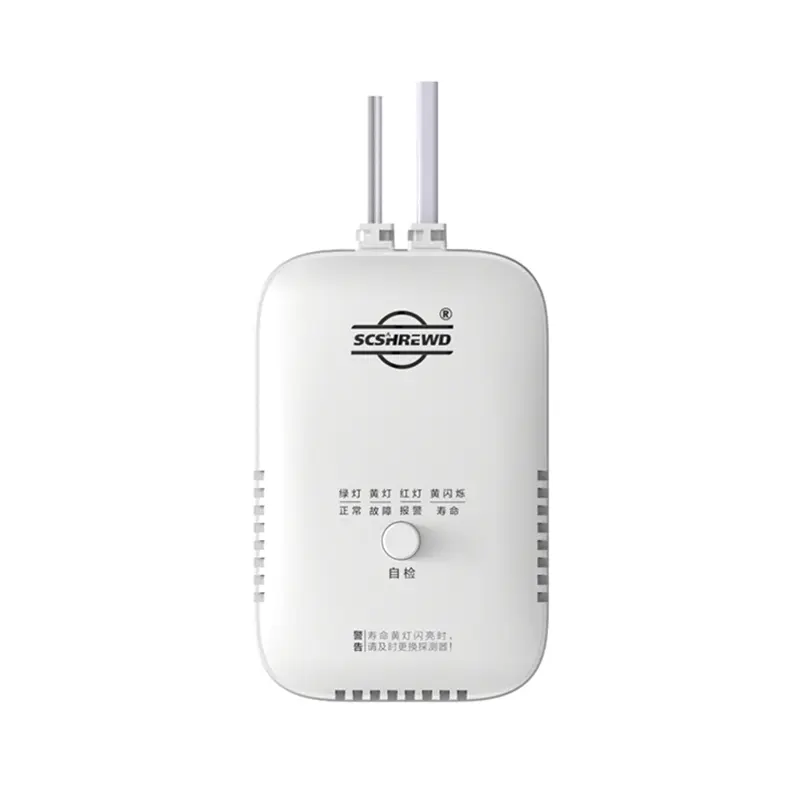
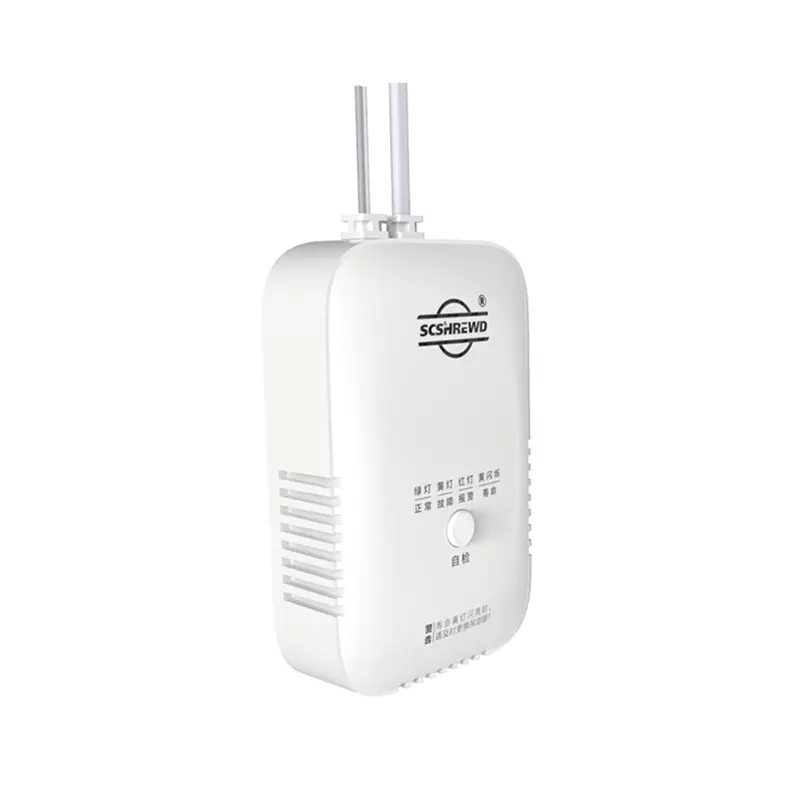
OEM Household Combustible Gas Detectors 6101 Series Supplier, Factory
Product Description
- High sensitivity, anti-interference, resistance to humidity and heat
- Audio-visual alarm and automatic output
- Automatic reminder of sensor life expiration
- Built-in alarm history function
- Easy to install and use
- Indoor use in residential homes
- Relative humidity: ≤93%RH
- Ambient atmospheric pressure: 86KPa~106Kpa
- Temperature: -25℃~+55℃
| Detection principle | Semiconductor type |
| Gas types detected | Methane (natural gas), propane (liquefied gas) |
| Alarm setpoint | 8% LEL or 10% LEL |
| Detection range | 0~25% LEL |
| Alarm mode | Sound and light alarm |
| Power supply | AC220V±15% (50Hz) |
| Power | <3W |
| Response time (T90) | ≤30s |
| Detector life | Five years (typical) |
| Installation | Wall-mounted |
| Linkage output (default) | One set of 12v pulse output (solenoid valve) |
| Dimension | 104x68x36mm |

| Model Number | SD6101 Series |
| Product Size | 104x68x36mm |
| Product Weight | Approx. 105g |


- Detectors should be installed in areas where indoor gases and vapors tend to collect.
- Installation of the detector should refer to the above installation diagram: when the target gas is lighter than air density, install above the release source; when heavier than air density, install below the release source. The mounting plate should be fixed and leveled reliably according to the indicated direction.
- Do not install the detector in areas with large air flow such as near ventilation fans, windows, or doors. Avoid positions directly exposed to heat, water vapor, and oil smoke (e.g., directly above gas stoves or smoke extractors).
- Ensure no obstructions exist between the detector and the gas-using equipment; do not install inside a closet or cabinet.
- Do not install where electrical power is turned off at night.
- In newly renovated rooms, install detectors only after painting and welding are completed, and maintain proper air circulation after installation.
- Do not scrub the detector with alcohol and do not spray insecticides directly on the detector to avoid affecting sensor performance.
- Do not smoke near the detector.
- Machine accessories: Product manual (1 piece), product certification (1 piece), mounting plate (1 piece), mounting screws accessories (1 piece).
- Open the box and check: Verify no scratches appear on the product, the label is complete and clear, and all accessories are fully included.
The SD6101 series utilizes a semiconductor sensor designed to detect Methane (natural gas) and propane (liquefied gas).
The typical detector and sensor service life is five years, and the device includes an automatic reminder feature when sensor expiration occurs.
If detecting gas lighter than air (e.g., natural gas/methane), mount the unit above the release source. If detecting gas heavier than air (e.g., LPG/propane), mount it below the release source as illustrated in the schematic.
It triggers both audio and visual (sound and light) alarms once gas levels reach 8% or 10% LEL, and includes a default 12V pulse output for triggering emergency shut-off solenoid valves.
Avoid drafty areas (fans, windows, doors), enclosed cabinets, locations subject to power outages at night, and locations directly exposed to steam, heat, or oil smoke directly over cooking appliances.
Never use alcohol to clean the exterior, avoid spraying insecticides nearby, and do not smoke close to the unit, as these substances can impair sensor accuracy and longevity.







